

back

Successful root canal treatment is the cornerstone of preserving natural dentition, and the quality of the instrument used for canal preparation is paramount. As a dental professional, selecting the right tool from the many available endodontic files types directly impacts the safety and efficiency of your procedure. Here at NIC Dental, we believe that superior clinical results start with superior engineering. This guide will walk you through the essential characteristics that define truly great root canal files, ensuring you have the knowledge to choose instruments that enhance your performance and patient care. We’ll break down key factors like material durability, canal adaptability, and fracture resistance—critical for navigating diverse anatomical challenges. With evidence-backed insights tailored to clinical practice, this resource empowers you to make informed decisions that elevate treatment predictability and patient outcomes.
Maximize Flexibility with Advanced Metallurgy
The defining characteristic of modern, high-quality root canal files is the metallurgical composition, specifically the use of advanced Nickel-Titanium (NiTi) alloys rather than traditional stainless steel. NiTi provides the flexibility and superelasticity necessary to navigate curved canals without straightening them, which minimizes the risk of canal transportation or iatrogenic errors. Our company, NIC Dental, utilizes cutting-edge heat treatments to produce alloys like our MaxTech 6.0, ensuring our files maintain maximum flexibility and exceptional resistance to cyclic fatigue fracture—a crucial feature for any root canal file system used in complex anatomy.
Reciprocating Kinematics for Enhanced Safety
While conventional rotary motion files operate with continuous 360-degree rotation, the best modern root canal file systems often employ reciprocating kinematics, which significantly improves safety and efficiency. Reciprocating motion involves alternating angles of rotation, reducing the stress applied to the file and minimizing the potential for screw-in effects and torsional fracture. This unique back-and-forth movement allows an instrument, such as our V Blue root canal file, to work effectively in a single-file concept, simplifying the clinical sequence and saving valuable chair time for both the clinician and the patient.
Cross-Sectional Design in Modern root canal files
The cross-sectional shape of the instrument determines its cutting efficiency, debris removal capacity, and centering ability within the canal. Different designs, such as triangular, square, or S-shaped, each offer distinct advantages. A key characteristic of the best root canal files is a design that maximizes cutting edges while creating sufficient space between the flutes for debris. At NIC Dental, we engineer instruments with features like the S-shaped cross-section found in our V Blue file, which provides two sharp cutting edges and a strong centering ability to shape the canal smoothly without applying excessive lateral pressure.
Preventing Coronal Dentin Loss with Regressive Taper
A characteristic that separates older designs from the new generation of root canal file systems is the taper profile along the instrument’s working length. Excellent files use a variable or regressive taper; this means the instrument is wider coronally only where necessary and becomes progressively less tapered towards the apex. This design principle ensures that the clinician is only removing the necessary amount of dentin, specifically preventing the unnecessary loss of sound tooth structure in the coronal third, which contributes directly to the long-term fracture resistance and structural integrity of the restored tooth. By focusing material removal on the coronal region where access and shaping are critical, variable taper files also enhance canal patency while minimizing apical transportation risks. This refined engineering balances effective preparation with tooth preservation, supporting more durable restorations and improved long-term clinical outcomes for patients.
Precision Specifications: The NIC Dental V Blue File
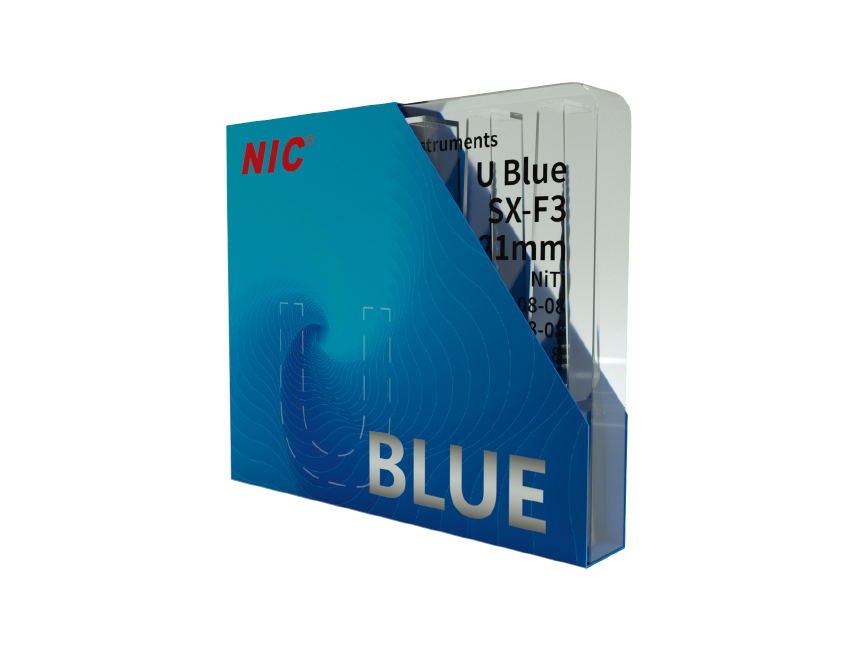
When selecting a root canal file, the specific technical specifications must be precise and repeatable. Our dedication to precision is exemplified by our flagship V Blue reciprocating system. Crafted with MaxTech 6.0 NiTi alloy, this system provides three sizes to predictably shape various canals: the R25 (tip diameter: 0.25 mm, apical taper: .08), the R40 (tip diameter: 0.40 mm, apical taper: .06), and the R50 (tip diameter: 0.50 mm, apical taper: .05). This precise range allows you to consistently achieve a clean, ideal shape, which is why dental professionals trust NIC Dental for their endodontic needs.
Conclusion: Trusting NIC Dental for Consistent Performance
In summary, the characteristics of truly superior root canal files combine material innovation (heat-treated NiTi), smart kinematics (reciprocating movement), and specific design (cross-section and regressive taper). Choosing a dependable system is an investment in your clinical confidence and the prognosis of your endodontic cases. As the first Chinese company to produce endodontic files types, NIC Dental has over two decades of experience and a global reputation for high-quality engineering. We continuously innovate to ensure our root canal files meet the highest standards of safety, efficiency, and clinical performance, making NIC Dental your trusted partner in precision dentistry. Our instruments are rigorously validated through clinical trials and quality control, ensuring consistent performance across diverse canal anatomies. Backed by responsive technical support and a commitment to advancing endodontic care, we empower dental professionals worldwide to deliver predictable, long-lasting results for their patients.