

back

Welcome to the world of precision endodontics. As dental professionals, we understand that successful root canal treatment hinges on accurate diagnosis, meticulous cleaning, and perfect shaping. The core instrument in this process is the endo file. Choosing the right file system is critical, as it directly impacts shaping efficacy, patient safety, and clinical efficiency. This guide, brought to you by NIC Dental, is designed to share our expert knowledge on the various endodontic files types available today, helping you select the instruments best suited for the unique anatomy presented in your operatory. We’ll break down key differences in design, material composition, and clinical applications—from rotary to reciprocating systems—demystifying technical nuances for practical use. Whether you’re navigating complex canal curvatures or prioritizing procedural speed, this resource equips you with data-driven insights to elevate treatment outcomes and streamline your clinical workflow.
Understanding the Foundational Difference in Metallurgy
The primary classification among endodontic files types rests on the material used: Stainless Steel (SS) versus Nickel-Titanium (NiTi). SS files, while still used for initial negotiation and patency, are stiff and prone to canal transportation in curved anatomy. In contrast, NiTi files revolutionized endodontics due to their superelasticity and shape memory. At NIC Dental, we specialize in advanced NiTi alloys, providing the flexibility required to safely navigate complex curvatures while minimizing iatrogenic errors and maximizing debris removal. Choosing the right alloy is the first step in optimizing your shaping protocol.
endo file Kinematics: Rotary vs. Reciprocating Systems
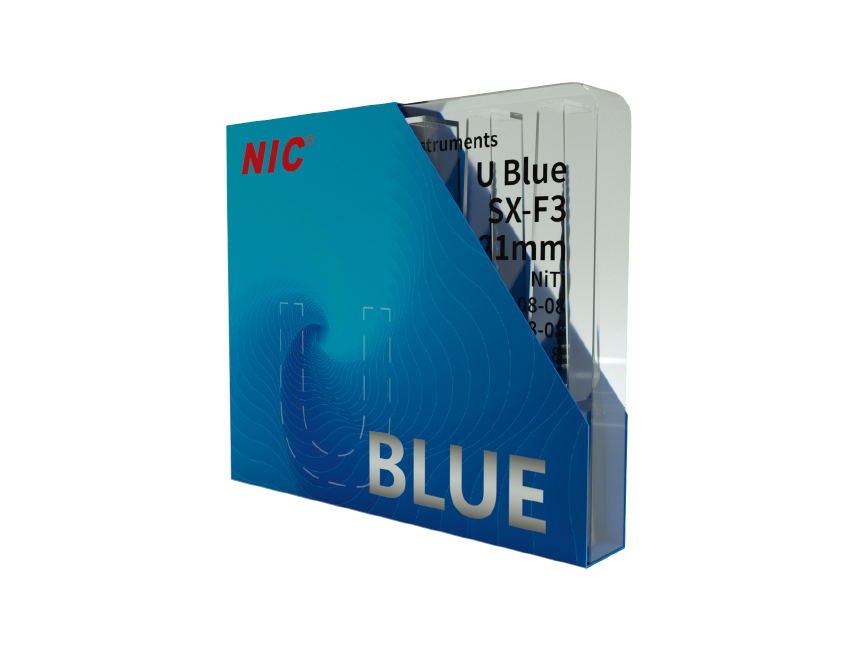
After selecting NiTi as the preferred material, clinicians must decide between continuous rotary and reciprocating motion. Rotary systems turn 360 degrees and typically require a sequence of multiple instruments to achieve a desired shape. Reciprocating systems, like our advanced V Blue system, utilize alternating clockwise and counter-clockwise movements. This specific kinematics dramatically reduces cyclic fatigue stress on the instrument, often allowing for a simplified, single-file technique. Our V Blue reciprocating endo file is designed to simplify the procedure, saving chair time without compromising the quality of the preparation.
Incorporating Design and Taper for Optimal Shaping
Beyond material and motion, the design elements—specifically the cross-section and taper—determine how the instrument cuts and moves debris. Our company, NIC Dental, meticulously engineers these elements to respect the natural root canal anatomy. For instance, the V Blue Reciprocating File employs an S-shaped cross-section, which provides superior cutting efficiency while ensuring adequate space for dentin chips to be extruded coronally. Furthermore, the innovative design features a regressive taper, which prevents unnecessary dentin loss in the coronal third of the tooth, a critical factor for long-term structural integrity.
Advanced Alloys: The MaxTech 6.0 Specification
The latest generational leap in endodontic files types involves thermomechanical treatment, often called controlled memory (CM) or heat activation. Our MaxTech 6.0 NiTi alloy, used in systems like the V Blue, undergoes a specific heat treatment process that alters the alloy’s crystalline structure. This process shifts the transition temperature, ensuring the file remains in the soft, flexible martensite phase at body temperature. This means our file can be gently pre-bent, offering maximum resistance to cyclic fatigue and torsional fracture, which is essential when treating calcified or severely curved canals. This commitment to metallurgical advancement is a cornerstone of NIC Dental's product development.
Precise Specification of Our V Blue Reciprocating endo file
When promoting safety and efficiency, precision is paramount. The V Blue system from NIC Dental offers three master endo file sizes to cover a wide range of canal anatomies: R25, R40, and R50. The R25 file features a tip diameter of 0.25 mm and a maximal taper of .08 in the apical third, ideally suited for standard canals. For wider preparations, the R40 features a 0.40 mm tip with a .06 taper, and the R50 offers a 0.50 mm tip with a .05 taper. This variable taper design ensures we create the necessary apical lock while preserving maximum dentin coronally, providing predictable shaping results every time.
Choosing the Right System: A Summary from NIC Dental
Selecting the appropriate instrumentation is not about finding a single "best" file, but rather finding the system that offers the most predictable and safe solution for various clinical challenges. For clinicians prioritizing ease of use, superior flexibility in curved canals, and maximal resistance to instrument separation, our MaxTech 6.0 heat-treated reciprocating endo file systems represent the cutting edge of endodontic files types. NIC Dental is dedicated to providing high-quality, scientifically validated instruments that enhance your performance and deliver excellent clinical outcomes. We encourage you to explore our comprehensive product library to find the perfect solution for your practice. Each MaxTech 6.0 file undergoes rigorous testing to ensure consistent performance across diverse canal anatomies, from narrow calcified canals to severe curvatures. Backed by our commitment to clinical support and innovation, our instruments empower you to tackle complex endodontic cases with confidence, elevating both procedural efficiency and patient care standards.